

What IT Leaders Stand to Gain from a Modern Application Development Approach

Andrew Jutton
Practice Director, Modern Application Development
Modern application development helps IT leaders reduce risk, accelerate delivery, and enable innovation. Learn what’s at stake and how to start.
Legacy applications don’t just slow innovation—they quietly increase operational risk, constrain growth, and limit an organization’s ability to respond to regulatory, security, and market change. But replacing them isn’t simple.
For IT leaders evaluating modernization strategies, the challenge is finding an approach that delivers measurable outcomes without unnecessary risk. Modern application development provides a proven framework for accelerating delivery, improving security, and building applications that evolve with your business.
What Modern Application Development Really Means
Modern application development is an approach to designing, building, and managing applications that increases software delivery speed, enables rapid innovation, and improves reliability, scalability, and security. It incorporates modern practices across development, DevOps, testing, security, infrastructure, and release management, helping organizations build software smarter.
Importantly, modern application development isn’t synonymous with “moving everything to the cloud” or “rewriting systems from scratch.” For most organizations, it’s about modernizing incrementally improving how applications are built, tested, secured, and evolved while continuing to deliver business value.
How Modernization Changes Everything
Modern applications represent a fundamental shift from traditional legacy systems. This change spans:
- Technical stack and architecture—faster scalability and reduced outage blast radius.
- Ways of working—how you build, test, release, and support software to reduce lead time for change and change frequency.
- Organizational processes—clearer ownership and reduced dependency bottlenecks to maximize efficiency and innovation.
These changes can be time-sensitive, risky, and costly. Yet, the business value far outweighs those challenges.
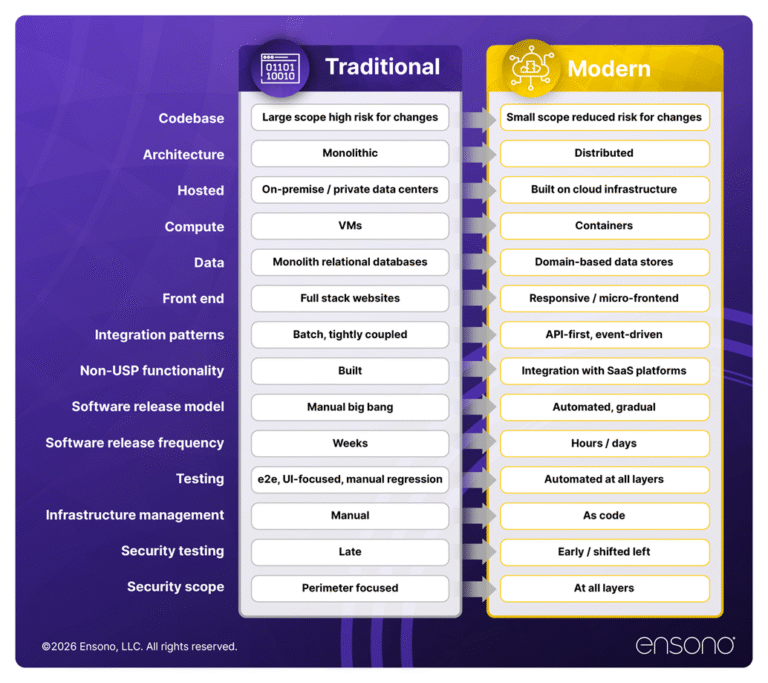
Compared with traditional solutions, modern practices reduce risk, accelerate delivery, and improve resilience across the entire application lifecycle. For example, traditional environments often rely on quarterly or biannual releases, manual testing, and change freezes. Modern approaches favor small, frequent releases, automated testing, and built-in rollback—reducing both the likelihood and impact of failure. A comparison between traditional and modern applications is below.
What Modern Applications Look Like
Modern applications share several defining traits that enable agility, resilience, and business value. They:
- Are designed to be more responsive to change.
Example: Business rules, user journeys, or integrations can be updated without large-scale regression testing or multi-team coordination, because changes are isolated and loosely coupled.
- Enable innovation and deliver value to customers.
Example: Product teams can test new features, pricing models, or customer experiences with a subset of users and iterate quickly based on real feedback rather than assumptions.
- Provide competitive advantage through differentiation and data-driven decision-making.
Example: Applications expose clean data and events that feed analytics, AI, or partner ecosystems—allowing the business to make faster, better-informed decisions than competitors.
- Mitigate risks associated with legacy systems.
Example: Critical business capabilities are no longer tied to single points of failure, unsupported platforms, or hard-to-replace specialists, reducing operational and people risk.
- Are highly available and scalable.
Example: Applications continue operating during peak demand or partial infrastructure failures, scaling automatically without manual intervention or planned downtime.
- Reduce IT costs.
Example: Infrastructure spend aligns closely with actual usage, support effort declines due to automation, and teams spend less time maintaining environments and more time delivering value.
- Lower risk when releasing updates.
Example: Updates can be released during business hours with minimal disruption, supported by automated testing and rollback.
- Increase the speed of change.
Example: Teams can move from idea to production in days rather than months.
Where to Start When Evaluating Your Options
IT leaders should start by assessing your current application portfolio and identifying areas where modernization will deliver the greatest impact. They should define clear goals and prioritize initiatives that align with business objectives.
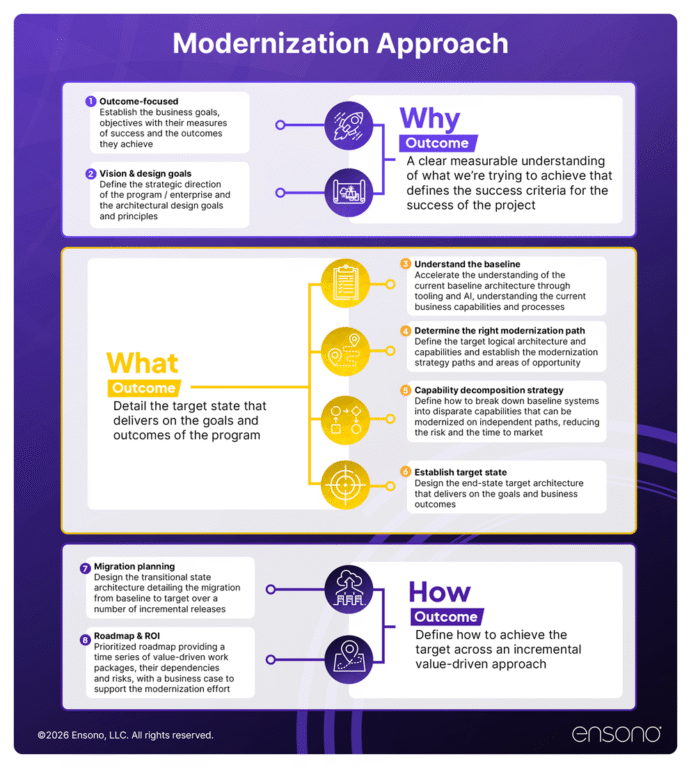
The why, what, and how approach to application modernization can help with this process. It connects business modernization goals—such as improving speed, performance, and cost efficiency—with practical technical enablers like containerization, modern DevOps practices, and continuous modernization.
Next Steps for IT Leaders
By adopting modern application development practices, IT leaders can reduce risk, accelerate delivery, and create a foundation for continuous innovation. Whether you’re addressing a single legacy system or transforming enterprise-wide, success depends on aligning modernization goals with business outcomes and building applications that evolve with your organization.
A structured assessment or modernization discovery can help establish where change will deliver the most value—and where it won’t. For many IT leaders, this clarity is the difference between confident progress and stalled transformation.
Interested in learning more? In this white paper, you’ll find practical frameworks, proven approaches, and insights to help you evaluate modernization options with confidence.
Frequently Asked Questions:
What is modern application development?
Modern application development is an approach that uses agile, cloud-native practices to build scalable, secure, and adaptable applications.
Why should IT leaders modernize applications?
Modernization reduces risk, lowers costs, accelerates delivery, and enables innovation—critical for staying competitive in today’s market.
What’s at stake if organizations delay modernization?
Delaying modernization can lead to higher security risks, slower delivery cycles, and increased operational costs.
How do modern applications differ from traditional ones?
Modern apps use distributed architectures, automation, and continuous delivery, unlike monolithic, manually managed legacy systems.
Where should IT leaders start with modernization?
Begin by assessing your application portfolio, defining SMART goals, and prioritizing initiatives based on business impact.
Social Share
Don't miss the latest from Ensono
Keep up with Ensono
Innovation never stops, and we support you at every stage. From infrastructure-as-a-service advances to upcoming webinars, explore our news here.
Blog Post | March 25, 2026 | Industry trends
AI Can Read COBOL. That Doesn’t Change The Mainframe Equation.
Blog Post | February 18, 2026
Overcoming the 10 Roadblocks to Successful Modernization
Blog Post | February 18, 2026 | Best practices