

Overcoming the 10 Roadblocks to Successful Modernization

Andrew Jutton
Practice Director, Modern Application Development
Modernization is essential, but far from simple. This blog breaks down the key challenges that make modernization difficult and why they matter.
The pressure to digitize has never been greater: 74% of business leaders rank it as a top priority. Yet the reality is stark—almost 70% of transformation initiatives fail to meet or exceed business outcome targets.
Why do so many efforts fall short?
It’s because navigating the 5 Rs of modernization is complex and touches upon several aspects of the business—technology, strategy, culture, processes. These key elements show why the journey so challenging.
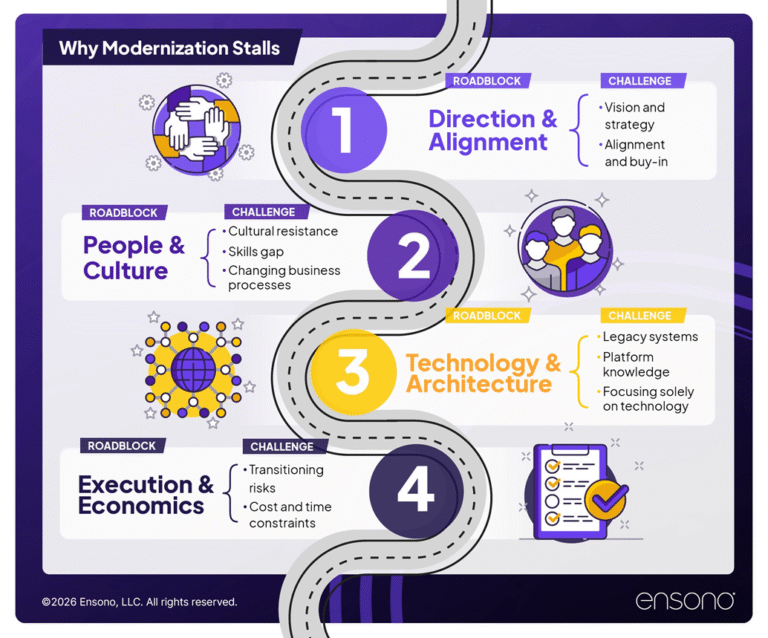

Roadblock:
Direction & Alignment
| Business challenge | Description of why it matters |
| Vision and strategy | A clear roadmap and phased approach are essential for success. Without them, the strategy lacks direction and measurable value. Example: You’ll recognize this when teams modernize individual systems without a shared roadmap, resulting in isolated wins but no measurable business impact. |
| Alignment and buy-in | Transformation goals must align with business objectives and evolve over time. Misalignment and unclear success measures derail progress. Example: This often shows when success is measured in migrated servers rather than improved customer experience, reduced risk, or faster delivery. |

Roadblock:
People & Culture
| Business challenge | Description of why it matters |
| Cultural resistance | Fear of job loss can hinder adoption. Resistance often spreads across teams with deep-rooted habits, slowing momentum. Example: Resistance typically surfaces when teams fear automation or cloud adoption will make existing skills obsolete rather than more valuable. |
| Skills gap | Outsourcing without knowledge-transfer creates gaps. Building internal capability alongside external expertise is critical for long-term success. Example: This becomes visible when external partners deliver change, but internal teams are unable to operate or evolve the solution afterward. |
| Changing business processes | Process changes introduce cultural resistance and integration complexity. These shifts require careful planning and communication. Example: Even well-designed platforms struggle when underlying processes remain manual, fragmented, or misaligned across teams. |

Roadblock:
Technology & Architecture
| Business challenge | Description of why it matters |
| Legacy systems | Legacy systems with complex dependencies and poor documentation make modernization risky. AI helps accelerate the understanding but isn’t a substitute for subject matter experts. Integration estimates often double without detailed upfront design due to insufficient architectural insight. Example: In practice, undocumented dependencies and hard-coded business rules frequently double integration effort once delivery begins. |
| Platform knowledge | Limited understanding of system capabilities complicates integration and migration. This gap increases development time and costs. Example: A lack of platform insight often leads to conservative estimates, delayed decisions, and over-engineered solutions—just in case. |
| Focusing solely on technology | Treating modernization as a technology upgrade erodes business buy-in. Without customer-driven value, support for the initiative fades. Example: Programs lose momentum when stakeholders struggle to see how modernization improves customer outcomes or business performance. |

Roadblock:
Execution & Economics
| Business challenge | Description of why it matters |
| Transitioning risks | Trying to change too much too soon can be overwhelming, so weighing the risk of change against timelines and cost is essential. Example: Risk spikes when organizations attempt “big bang” change instead of isolating and modernizing high-value capabilities first. |
| Cost and time constraints | Underfunded plans and shortcuts compromise quality. Rushed timelines often lead to missed objectives. Example: Under pressure, teams cut testing, documentation, or automation—increasing long-term risk while appearing to save short-term cost. |
How to Overcome these Challenges
Modernization isn’t a one-time technology upgrade—it’s a continuous, strategic journey that focuses on business outcomes and adopts modern application development practices to enable speed and resilience. Success depends on three fundamentals:
- Anchor modernization to business outcomes: Define SMART goals (Specific, Measurable, Achievable, Relevant, and Time-bound) tied to driving business value—such as efficiency, speed, or growth—not just technical milestones.
- Deliver change incrementally: Use pilots, phased delivery, and progressive decoupling to reduce risk and maintain business continuity. For example, many organizations succeed by first stabilizing and integrating legacy systems before attempting deeper rearchitecture or rebuilds—reducing risk while still enabling faster change at the edges.
- Embed collaboration and governance: Align stakeholders, establish clear ownership, break down silos, manage dependencies, and maintain transparency through strong leadership and architecture governance, introducing shared success measures to sustain momentum.
Other critical factors include application rationalization, robust integration patterns, automation, and data-driven metrics like DORA to track progress. These layers of complexity are why many organizations struggle to modernize alone. Since modernization spans strategy, architecture, delivery, and culture, many organizations benefit from proven frameworks and experienced guidance to avoid common pitfalls and accelerate value.
Modernization is Hard. Ensono Makes it Easier.
Modernizing legacy applications is complex. Dependencies, cultural resistance, and risk can make the journey feel overwhelming. But with the right partner, it doesn’t have to be. Ensono brings tested methodologies, phased strategies, and deep expertise to help you modernize with confidence, reduce risk, and keep your business running smoothly.
Explore our white paper for practical guidance and insights to turn modernization from a daunting challenge into a strategic advantage.
________________________________________________
Frequently Asked Questions:
Why is application modernization so challenging?
Modernization involves complex dependencies, cultural resistance, and risk factors that make it difficult to execute without a clear strategy.
What are the biggest obstacles to modernization?
Common hurdles include legacy systems, the lack of documentation, skills gaps, and misaligned business objectives.
Does modernization mean replacing all legacy applications?
Not always. Many organizations choose incremental modernization to reduce risk and maintain business continuity.
How do legacy systems complicate modernization?
Legacy systems often lack documentation, have tightly coupled integrations, and depend on scarce expertise, making transitions harder.
What happens if modernization fails?
Failed initiatives can lead to wasted resources, operational disruption, and missed opportunities for agility and growth.
Social Share
Don't miss the latest from Ensono
Keep up with Ensono
Innovation never stops, and we support you at every stage. From infrastructure-as-a-service advances to upcoming webinars, explore our news here.
Blog Post | 25 March 2026 | Industry trends
AI Can Read COBOL. That Doesn’t Change The Mainframe Equation.
Blog Post | 18 February 2026 | Industry trends
Control, Context, Correctness: How Spec-Driven Development Actually Works
Blog Post | 17 February 2026 | Industry trends